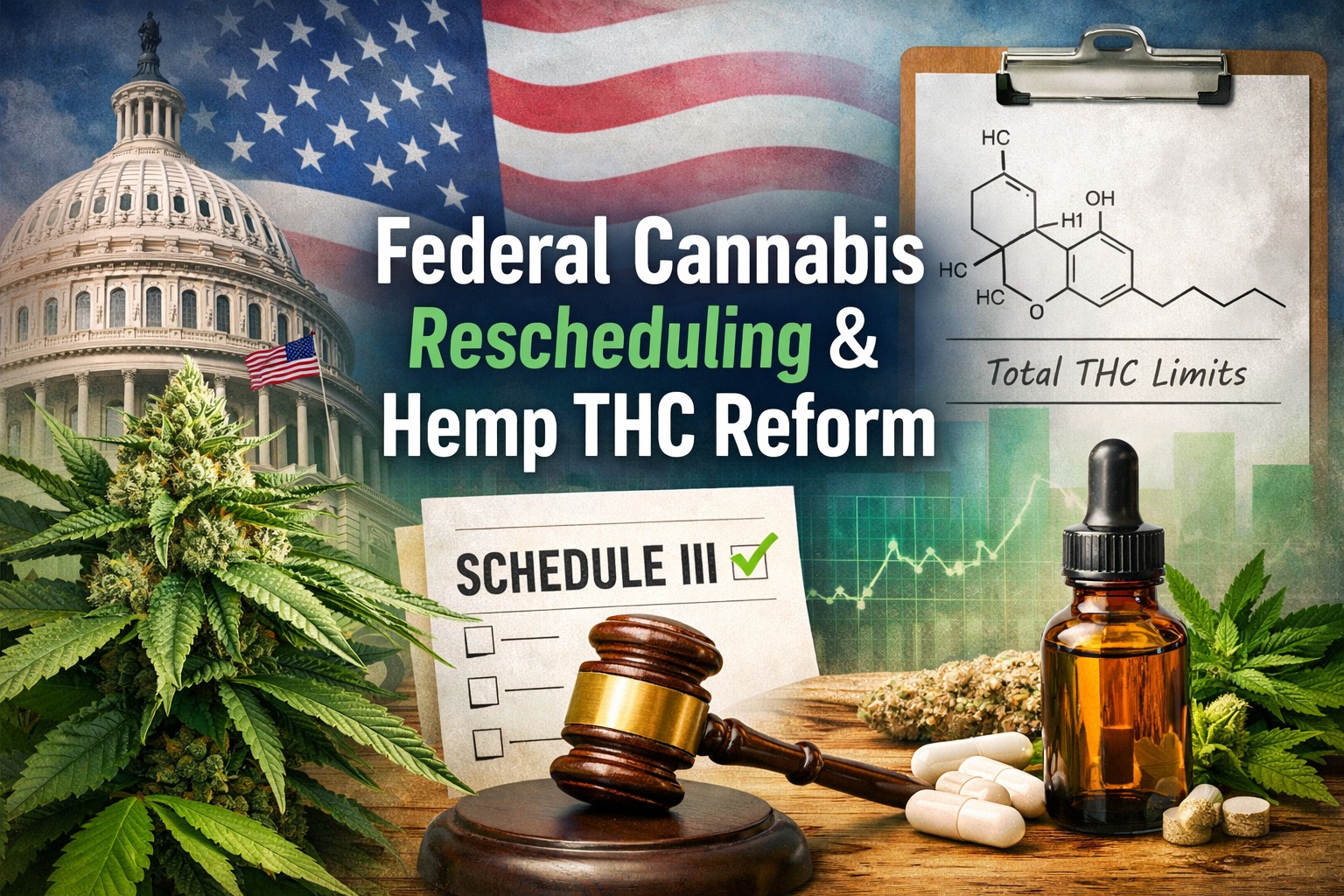
The end of 2025 and the beginning of 2026 have been pivotal for the hemp and broader cannabis industries. Industrial Hemp Farms (IHF) believes it’s essential to keep customers informed about legal changes that affect the products they love. Two intertwined issues dominate the conversation: federal rescheduling of cannabis and new federal rules that redefine hemp and restrict THC content.
The U.S. government classifies drugs into schedules based on perceived medical value and abuse potential. Since 1970 cannabis has been listed under Schedule I, the most restrictive category. In December 2025, President Donald Trump issued an executive order directing Attorney General Pam Bondi and the Department of Justice to move cannabis from Schedule I to Schedule III. This change, if adopted, would acknowledge that cannabis has accepted medical use, making it comparable under federal law to substances such as ketamine or certain steroids.
Rescheduling is not immediate. After receiving a record 43,000 comments, the DEA must review submissions, conduct hearings and issue a final rule. The Marijuana Policy Project notes that the DOJ and DEA still need to finalize the rule, and there is no definitive timeline. Nevertheless, the executive order signals a major shift in federal cannabis policy.
If cannabis moves to Schedule III, several important changes could follow:
Research & medical access: Rescheduling would ease barriers to scientific research and reduce the stigma surrounding medical cannabis.
Tax relief for businesses: Section 280E of the Internal Revenue Code currently prevents cannabis companies from claiming normal business deductions. Being reclassified could enable companies to deduct expenses like any other business.
Potential regulatory uncertainty: It remains unclear whether the FDA and DEA will treat cannabis like other Schedule III drugs, which require strict approval processes. Will existing retail markets continue, or will producers need DEA licenses? The answer is still pending.
Separate from rescheduling, the federal government has also rewritten the definition of legal hemp. A November 2025 continuing resolution (H.R. 5371) introduced a “total THC” standard limiting finished hemp products to no more than 0.4 mg of total THC per container. U.S. Hemp Roundtable counsel Jonathan Miller warned that this limit could eliminate 95% of hemp‑derived THC products. The legislation effectively threatens many full-spectrum CBD gummies, beverages and other products, especially those featuring delta‑8, delta‑9 or delta‑10 cannabinoids.
Industry groups are fighting back. The U.S. Hemp Roundtable is working with Congress to extend the compliance deadline and to raise the per‑serving limit to 5 mg. Senators Ron Wyden and Jeff Merkley introduced the Cannabinoid Safety and Regulation Act (CSRA) in December 2025. The bill would keep hemp legal while creating a national regulatory regime, including packaging standards and a 5 mg THC per‑serving cap.
Because the spending bill’s THC cap takes effect in November 2026, legislators are scrambling to either modify or postpone it. In January 2026, Senators Amy Klobuchar (D‑MN), Rand Paul (R‑KY) and Jeff Merkley (D‑OR) introduced the Hemp Planting Predictability Act. This bipartisan measure — mirrored in the House by Representative Jim Baird — would delay the federal hemp‑THC ban by three years, giving Congress time to craft a regulatory framework that protects consumers without destroying the industry. Stakeholders argue that age gating, testing, labeling and reasonable limits are better than an outright ban.
Meanwhile, some states are moving ahead on their own. New Jersey enacted a law in January 2026 that aligns with the federal total‑THC standard, reclassifying products exceeding 0.4 mg THC per container as cannabis and requiring licensure. Indiana and Alabama are considering similar restrictions, and Chicago has moved to ban most hemp‑derived products entirely. These state actions underscore the urgency of federal clarity.
Industrial Hemp Farms (IHF) offers a wide range of hemp‑derived products — from CBD tinctures and gummies to THCa flower and delta‑9 beverages. Here’s what rescheduling and federal reform could mean for our business and for you, our customers:
Greater tax fairness & growth potential – If cannabis is reclassified, hemp businesses could deduct ordinary expenses and access better banking and investment options. This could spur innovation and help us continue offering quality products at competitive prices.
Expanded research and product development – Easing federal research restrictions would allow universities and private companies to better study cannabinoids, leading to safer, more effective products. IHF invests in research partnerships and welcomes this opportunity to improve our formulations.
Tighter product standards – The new total‑THC rule (if implemented) would require many products to be reformulated or labeled differently. IHF is already exploring lower‑THC formulations and non‑intoxicating cannabinoid blends to ensure continued compliance.
Uncertain regulatory landscape – With no final rule yet, we’re preparing for multiple scenarios. Whether rescheduling leads to full FDA oversight or a more flexible regime, IHF will prioritize transparency and compliance.
Advocacy and customer voice – Policy decisions aren’t final. Industry groups and advocacy organizations continue to lobby for sensible regulations that keep hemp products available. As a consumer, you can make a difference by contacting your representatives and supporting organizations that champion reasonable hemp policy.
At Industrial Hemp Farms, we’re committed to keeping you up to date on the rapidly evolving legal environment. We encourage you to:
Subscribe to our newsletter and follow our blog for regular updates on federal and state policies.
Support responsible reform by engaging with advocacy groups like the U.S. Hemp Roundtable and the Marijuana Policy Project.
Provide feedback – Let us know which products you rely on and why. Your stories help industry advocates illustrate the human impact of regulatory decisions.
The coming months will shape the future of both hemp and cannabis in the United States. The rescheduling initiative could unlock research and economic opportunity, but the total‑THC standard threatens to disrupt the very products that introduced many Americans to hemp. Legislators are weighing whether to delay the ban and adopt a more measured, regulated approach.
Industrial Hemp Farms stands for transparency, quality and access. We’ll continue to adapt our product line to meet regulatory requirements while advocating for policies that protect consumer choice and support our community of growers, processors and customers.
Stay tuned — together we can shape a future where hemp thrives.
